


 English
 عربى
Water Bottle Lid Checks & Closing Sequence Review

Water Bottle Lid Checks: What Happens Between Open and Closed?
An assembled bottle can look finished in a photograph while leaving the buyer unsure how its lid behaves in a user's hands. The first turn, the final seated position and the steps between drinking and packing it away are all part of the product experience. Water bottle lid checks should follow that sequence instead of stopping at an image of a closed cap.
For brands and distributors, this is an opportunity to make the sample review specific. The objective is to identify the actual operation, confirm what the supplier intends and turn the result into clear product information. It is not a substitute for a defined performance test or permission to describe an untested bottle as leakproof.
One sample, one complete operating sequence
Begin with the exact model and lid version. Plastic infuser bottles may combine a cap, internal component, seal and carrying feature in different ways. Identify which parts are supplied and obtain the instructions that apply to the selected version.
Read the instructions before operating the sample. Note whether the user turns, lifts, presses or releases anything and in what order. Do not force a component because a visually similar bottle opens differently. A confusing step is a question for the supplier, not an invitation to improvise a new method.
Keep the bottle and its original parts together through the review. Swapping lids between similar samples can conceal a fit concern or create a mismatch unrelated to the ordered product. Record the sample reference so later observations refer to the same assembly.
Opening: can the user understand the starting point?
Observe the grip area and any indication of how the cap is released. Ask whether the intended movement is understandable from the supplied instructions and product markings. Do not infer a one-handed function or a lock from a shape that merely resembles those features.
Look at what becomes loose or removable during opening. A cap, seal or infuser should be described according to the actual design. If a part must remain in a particular position, ask how that requirement will be communicated without relying on a verbal demonstration at the sample meeting.
The opening step also reveals access for filling. Review it with the intended use information supplied for the product. Avoid adding hot-liquid, dishwasher or other suitability statements that have not been confirmed for the offered material and construction.
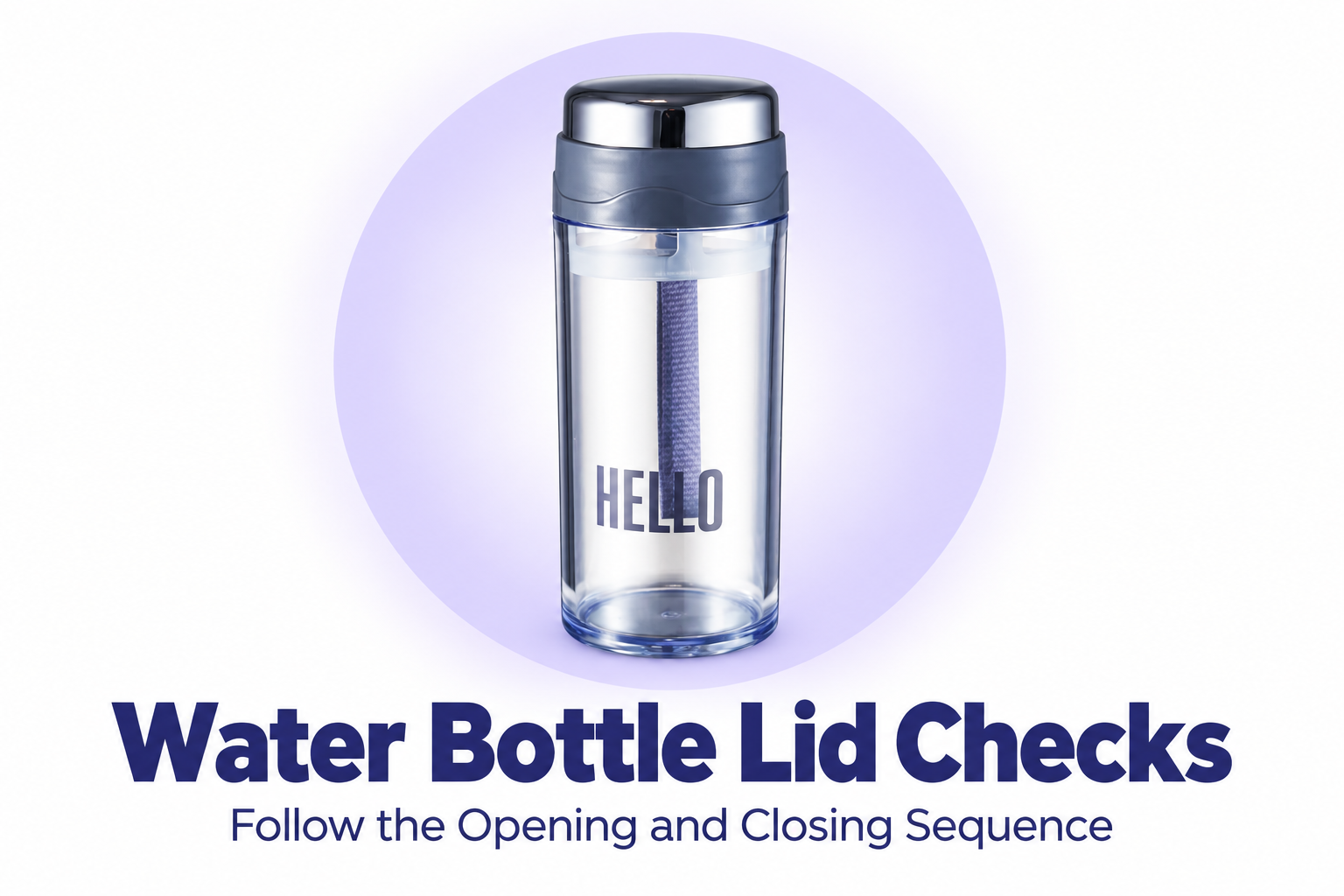
Closing: distinguish alignment from sealing performance
Follow the bottle lid closing sequence exactly as instructed. Note the starting engagement and final position. Water bottle cap alignment should be reviewed with the body, handle or drinking feature where relevant, rather than considered as an isolated cap photograph.
A cap that looks seated is an observation about the assembly. It does not establish sealing performance under transport, pressure, temperature or repeated use. If the buyer needs a specific performance claim, agree the method and acceptance criteria with the supplier and obtain evidence for that exact construction.
Ask the supplier how users should recognize that the lid is properly closed. Instructions should not rely on an undefined request to tighten as much as possible. The manufacturer's intended method is the relevant reference, including any limits or precautions for the design.
| Stage in the sequence | Observation to record | Question to resolve |
|---|---|---|
| Before opening | Model, lid and supplied components | Are all parts the correct version? |
| Releasing the cap | Required action and grip location | Does the instruction describe the actual movement? |
| After opening | Loose or exposed components | What must remain assembled or be retained? |
| Beginning closure | Alignment and engagement | How does the user start the intended connection? |
| Final position | Seated appearance and nearby features | How is correct closure indicated? |
| After approved care | Assembly and instructions | Can the parts be refitted as specified? |
Seals and removable parts need their own explanation
If a seal can be removed for care, obtain the approved removal and refitting instructions. Its location and orientation should be clear in the relevant product information. Do not assume that every visible ring is user-removable or that every gasket fits either way.
Review the sequence after the permitted care procedure, using the same components. A sample that closes easily before disassembly may still leave an instruction gap when the user must refit an internal part. Document that gap with photographs and ask for the correct procedure.
Keep this review separate from material compliance. Understanding how a seal fits does not establish its composition or regulatory status. Any required food-contact information should be requested for the offered component and target market through the appropriate documentation process.
Turn observations into usable sample decisions
Write down what was seen, what was confirmed and what remains unanswered. A note such as lid good is difficult to use later. A record identifying the cap version, operation and agreed instruction revision provides a clearer purchasing reference.
Where a repeated-operation test is required, define it separately. The number of cycles, conditions and pass criteria should come from the agreed verification plan. Opening a sample several times during a meeting should not become a published durability figure or an unsupported service-life claim.
Photographs can support the record if they show the critical action and component identity. Use real sample views rather than a diagram that adds a mechanism not present on the product. Keep captions descriptive and avoid words such as guaranteed sealing unless the claim is supported and approved.
Before approving the retail instructions
- Match the instruction to the actual bottle and lid version.
- Show the required opening action in its intended order.
- Explain loose parts and any permitted seal refitting.
- Describe how correct closure is recognized.
- Keep performance claims tied to a defined evidence record.
- Recheck instructions when the lid or internal components change.
The strongest sample review follows the same journey as the user: opening, filling, closing, drinking and approved care. Send the observations to the supplier with the sample reference so the final instructions describe the bottle that will actually be delivered.
Related Products
We specialize in the production and sales of plastic water cups, and also provide customization services
and comprehensive after-sales support.
QUICK LINKS
CONTACT US
- Address:No. 1 Shuangyou Road, Nancheng Street, Huangyan District, Taishan City, Zhejiang Province
- Tel: +86-19957687783
- Email: [email protected]
- Whatsapp: +86-19957687783
MOBILE
Copyright © Taizhou Huangyan Zuohao Plastic Factory.
All Rights Reserved.
