


 English
 عربى
News

Water Bottle Capacity Markings: Define the Volume Before Printing
A printed scale can make a reusable bottle easier to understand, but it also creates a specification that needs checking. A capacity shown in a product title, the highest line on the body and the volume available with the lid fitted may describe different things. Water bottle capacity markings should be defined before artwork is released.
For private-label buyers, the useful question is how the stated volume relates to the actual product and intended filling practice. A clear reference makes supplier comparisons more meaningful and helps avoid conflicting numbers on the bottle, packaging and online listing.
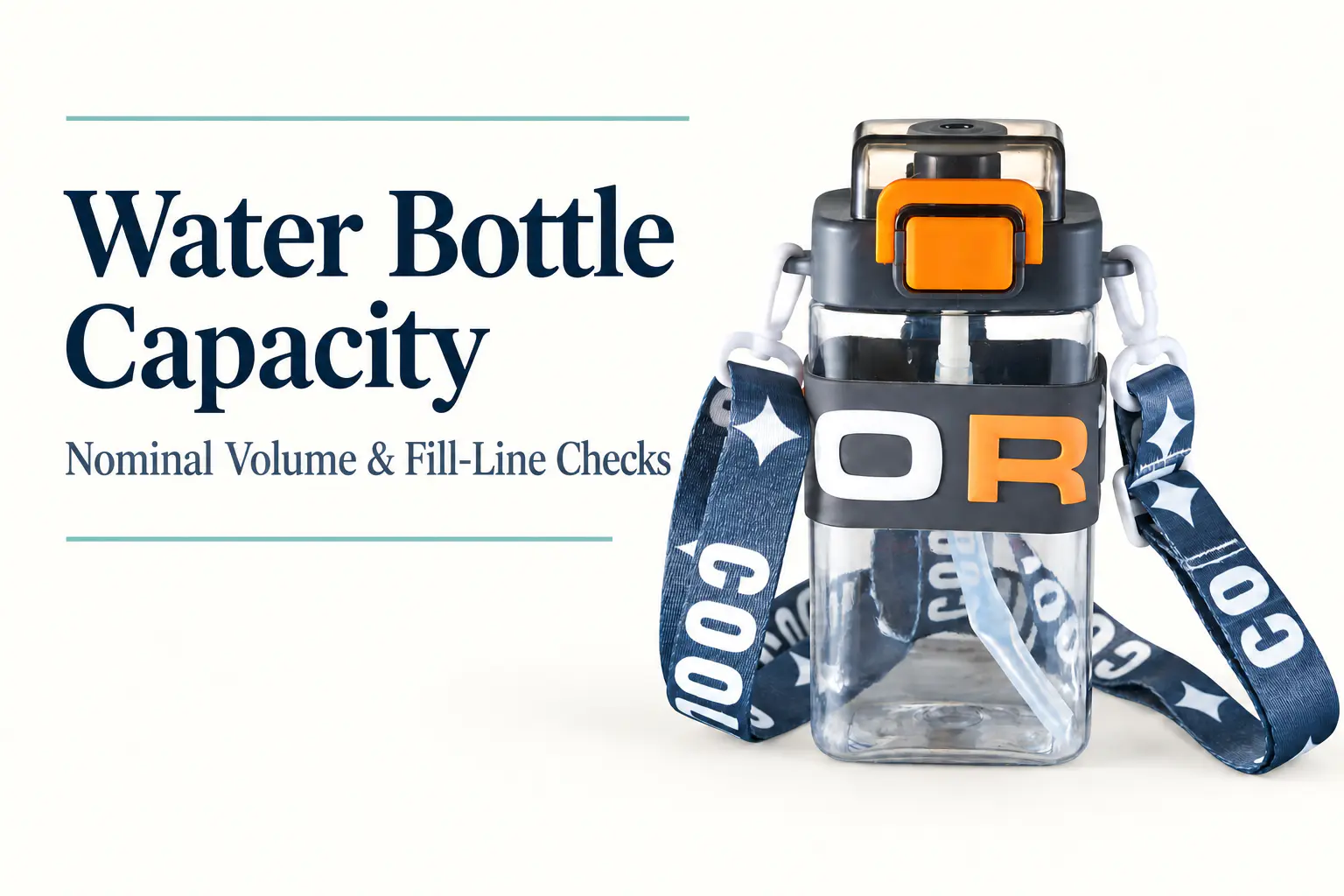
Define the claimed capacity
Ask what the nominal bottle capacity represents for the offered model. Does it refer to a defined fill line, another specified level or a different measurement convention? Obtain the supplier's explanation rather than assume that every catalogue uses the same basis.
When comparing the plastic straw bottle range, identify the exact body and closure combination. A similar shape can be offered in several sizes, and optional parts may affect the intended filling arrangement. Connect the capacity statement to the product code being purchased.
Do not estimate volume from outside dimensions or a product photograph. Wall shape, internal features and the selected fill reference all matter. If the capacity is important to the buying brief, request a documented measurement method and the relevant result for the sample.
Distinguish a fill reference from total internal space
A bottle is not necessarily intended to be filled to its absolute top. The lid, straw or other components may require a particular filling practice, depending on the design. Ask the supplier to identify the recommended fill level and any relevant use instructions.
The purpose is to avoid a contradiction between the printed number and the way the product is meant to be used. If a marketing description refers to one basis while the highest line uses another, explain the distinction or revise the description before launch.
Keep temperature and liquid-use limitations separate from the capacity claim. A volume label does not establish suitability for hot drinks, carbonated liquids or other uses. Include only the instructions supported by the offered product documentation.
Choose units that the intended customer can read
Decide which units are required for the market and listing. If more than one scale is used, label each clearly and have the artwork checked for consistency. Do not place unlabeled numbers beside the scale and expect the customer to infer their meaning.
The artwork should state which unit system is intended. A broad abbreviation can become ambiguous across markets, so resolve the required wording with the relevant reviewer. Keep the approved unit labels consistent across the bottle, carton and digital product information.
Avoid adding too many competing scales or decorative messages around the same area. The marking should remain readable against the body colour and normal contents. A technically correct number loses practical value if the user cannot tell which line belongs to it.
Check line positions on the real product
Bottle fill-line approval requires the actual bottle, not only a flat artwork file. Ask how the line positions are established and how the proposed scale will be checked. The procedure should identify the sample, fill reference, measuring equipment and agreed acceptance criteria.
Do not assume that equally spaced printed lines represent equal volume increments on a shaped bottle. The supplier should establish the line locations for that body geometry. A graphic designer should not create the scale by dividing the visible height into equal sections without technical input.
If the body design changes, review the scale again. A new shoulder, base or cross-section may affect the relationship between liquid height and volume. Reusing an old decoration file without checking the new product can carry a hidden mismatch into production.
Use a capacity approval record
| Approval field | What to record | Why it matters |
|---|---|---|
| Model identity | Body, size and closure references | Connects the scale to one product |
| Capacity basis | Defined level and measurement method | Explains the nominal volume claim |
| Unit system | Exact units and printed wording | Avoids ambiguous or conflicting scales |
| Artwork position | Revision and alignment reference | Makes the approved line locations reproducible |
| Sample review | Observed measurements and agreed criteria | Documents what was actually evaluated |
| Public wording | Bottle, packaging and listing descriptions | Keeps customer-facing information consistent |
This is a purchasing record, not a declaration that a bottle is a calibrated measuring instrument. If a buyer intends to make a precision measurement claim, that requirement needs its own technical and applicable regulatory review.
Approve the artwork on a filled sample
Discuss bottle customisation options with readability in mind. Review the printed sample empty and under the intended viewing conditions with suitable contents. Check whether the markings are visible against the bottle colour and whether nearby decoration interferes with the scale.
Confirm the numbering sequence, unit labels and line alignment. Check every visible value rather than approving the overall appearance alone. A missing zero or displaced line may be easy to overlook in a small image but significant on the finished product.
If the product uses a sleeve or strap, check the assembled condition too. A scale hidden by an accessory may be less useful than the flat artwork suggests. Decide which markings should remain visible in ordinary use and record the approved arrangement.
Keep production and product listings aligned
Once the sample is approved, retain the artwork revision and capacity reference with the order. Ask how proposed changes to the body or printing position will be communicated. Changes should be reviewed before the supplier uses the revised combination for production.
- Confirm what the capacity number means for the selected model.
- Agree the units, fill reference and checking method.
- Review the scale on the actual printed bottle.
- Check visibility with the supplied accessories fitted.
- Use the same approved capacity wording in packaging and listings.
Send the supplier your intended capacity statement and decoration requirements together. That connects the purchasing claim with the physical product and gives the team a clear basis for approving a scale that customers can read and understand.
Related Products
We specialize in the production and sales of plastic water cups, and also provide customization services
and comprehensive after-sales support.
QUICK LINKS
CONTACT US
- Address:No. 1 Shuangyou Road, Nancheng Street, Huangyan District, Taishan City, Zhejiang Province
- Tel: +86-19957687783
- Email: [email protected]
- Whatsapp: +86-19957687783
MOBILE
Copyright © Taizhou Huangyan Zuohao Plastic Factory.
All Rights Reserved.
